September is National Recovery Month, and most of what gets written about it focuses on the moment someone decides to get help. Less gets written about the months after that decision, the actual sessions, the actual counselor, the actual work.
If you’re picturing therapy as an hour of talking about your childhood while your drinking or drug use stays exactly the same, you’re picturing something outdated. Here’s what individual addiction therapy in Massachusetts actually involves, and what to check before you commit to someone.
What a Real Session Looks Like Week to Week
Individual addiction counseling in Massachusetts typically means a licensed clinician working with you one-on-one, usually 45 to 60 minutes, to identify the patterns that keep substance use in place. The goal is replacing those patterns with something that actually holds up under stress, not just talking through the week. Most people attend weekly at first, though the total length of treatment varies by individual need rather than following a fixed timeline.
Early sessions focus on stabilization and building a working relationship with your counselor. Later sessions shift toward skill practice and relapse prevention planning.
That later stage is also where you process whatever’s driving the use, whether that’s untreated anxiety, family conflict, or old trauma. The schedule typically loosens as you build stability.
The specific tools your counselor uses matter too. Cognitive Behavioral Therapy helps identify the thought patterns that show up right before use, so you can catch them earlier each time.
Dialectical Behavior Therapy focuses on managing intense emotions without reaching for a substance, which matters most for people who describe their use as a way to turn the volume down on everything. Motivational Interviewing works differently still, less about teaching a skill and more about working through your own ambivalence.
Almost nobody arrives at their first session feeling 100 percent ready to change everything at once, and a good counselor knows that going in. None of these approaches require you to pick one in advance, since a good counselor moves between them depending on what a given week calls for.
The substance underneath varies a lot depending on who’s sitting across from you, which brings up the part almost nobody explains clearly.
Why the Letters After Your Counselor’s Name Actually Matter
Massachusetts licenses addiction counselors through the Bureau of Substance Addiction Services (BSAS), not through a generic therapy board. The requirements differ sharply by tier.
A Licensed Alcohol and Drug Counselor I (LADC I) holds a master’s degree, has completed supervised clinical hours, and has passed a certification exam through the state’s licensing process. That combination qualifies them for independent practice and for supervising other counselors.
A Licensed Alcohol and Drug Counselor II (LADC II) can practice with a high school diploma or equivalent plus 270 hours of approved training and thousands of hours of supervised experience. LADC IIs work under direct clinical supervision rather than independently, per the eligibility structure laid out in 105 CMR 168.006.
A Licensed Mental Health Counselor (LMHC), by contrast, is a separate master’s-level credential issued through a different licensing board entirely. It’s built around general mental health treatment rather than substance use disorder counseling specifically.
Some LMHCs have substantial addiction training. Many don’t, and there’s no requirement that they do.
None of this means one license is “better” than another for every situation. It means the credential tells you something concrete about what your counselor was actually trained and examined on, which is worth asking about directly during your first call.
This also matters for a practical reason. Insurance plans and referring physicians sometimes ask specifically which license type provided a given service, particularly for documentation tied to level-of-care decisions.
Knowing the difference ahead of time saves you a confusing phone call later. A legitimate Massachusetts program should be able to tell you, without hesitation, which license each of its counselors holds.
If Nothing Has Worked Before, Therapy Alone Might Not Be the Starting Point
Weekly individual counseling works well for a lot of people, but if you’ve tried outpatient therapy before and the substance use kept escalating anyway, that’s useful information rather than a failure on your part. It usually means the level of care needs to go up before individual therapy can do its job, not that therapy itself doesn’t work.
Real Recovery Centers is a BSAS-licensed outpatient treatment provider in Chelmsford, offering Partial Hospitalizationand Intensive Outpatient programs that build individual counseling into a fuller schedule of structured, evidence-based care. Our programs accept most major Massachusetts insurance plans and offer flexible scheduling built around work and family responsibilities.
Our admissions team can verify your insurance before you commit to anything. Call (978) 788-1870 any time to talk through what level of care actually fits where you are right now.
How Individual Therapy Fits Into a Fuller Continuum of Care
Individual counseling rarely stands alone in a well-built treatment plan. It’s usually paired with group sessions that reinforce the same skills in a shared setting.
For people whose substance use is tangled up with untreated anxiety, depression, or trauma, that plan often includes dual diagnosis care. Both conditions are treated by the same clinical team, rather than sending you to two separate providers.

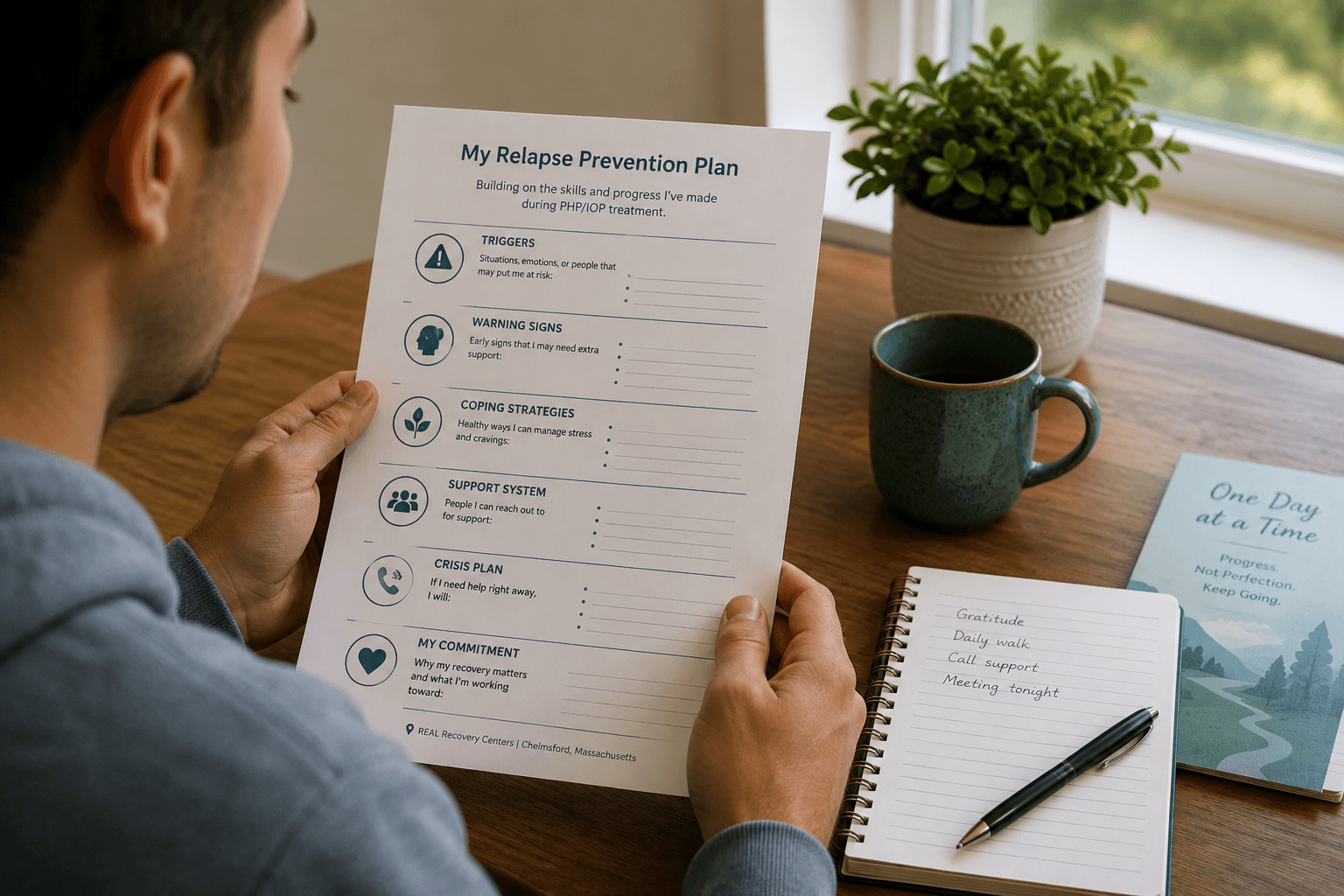
The same counselor who sees you weekly for individual sessions typically also coordinates your relapse prevention planning as you get closer to finishing a structured program. That way, the skills you build in session translate into an actual plan for the weeks after treatment ends, not just insight without a next step.
Frequently Asked Questions
How often will I meet with my individual counselor?
Most people start with weekly sessions, then move to every other week or monthly as stability builds, depending on your clinical team’s recommendation.
Do I need a specific diagnosis to start individual addiction counseling?
No. A licensed counselor will complete an assessment during your first session to understand what’s going on and recommend a starting point, whether that’s individual counseling alone or a more structured program.
What’s the difference between an LADC and an LMHC?
An LADC is licensed specifically in substance use disorder counseling through the Massachusetts Bureau of Substance Addiction Services, while an LMHC is a general mental health credential through a separate board that may or may not include addiction-specific training.
Will my insurance cover individual addiction therapy in Massachusetts?
Most major Massachusetts insurance plans include coverage for licensed addiction counseling, though the details vary by plan. Verify your insurance before your first appointment so there are no surprises.
Can individual therapy alone treat a substance use disorder, or do I need a structured program too?
It depends on severity and history. Individual counseling alone works well for some people, especially earlier in a problem or after completing a higher level of care, while others need the daily or weekly structure of PHP or IOP alongside it to actually get traction.
What happens in the very first session?
Your counselor will ask about your substance use history, any co-occurring mental health concerns, your support system, and what’s brought you in now, then use that information to recommend a starting point together with you, not for you.
Find a BSAS-Licensed Counselor This Recovery Month
If you’re in Massachusetts and ready to talk to someone, call Real Recovery Centers at (978) 788-1870 or reach out through our contact page to schedule an assessment with a BSAS-licensed clinical team in Chelmsford.
If you’re outside Massachusetts, our program isn’t able to admit you directly, since treatment here requires Massachusetts presence. A national support resource can help connect you with options in your own state.

About Real Recovery Centers
Real Recovery Centers is a BSAS-licensed outpatient addiction treatment provider at 67 Parkhurst Avenue, Chelmsford, Massachusetts (01824). We serve Greater Lowell, Middlesex County, and surrounding Massachusetts communities with individual counseling, PHP, IOP, dual diagnosis care, and aftercare support.
Most major Massachusetts insurance plans are accepted. 24/7 admissions: (978) 788-1870.

Mitchell Grant Cohen
Dr. Mitchell G. Cohen is a board-certified Internal Medicine specialist with over 34 years of experience in patient-centered healthcare. A graduate of Hahnemann University School of Medicine, Dr. Cohen completed his internship at the University Health Center of Pittsburgh, where he gained invaluable hands-on experience. He is also a certified addiction specialist, holding membership with the American Society of Addiction Medicine (ASAM).
Currently based in Nashua, NH, Dr. Cohen is affiliated with Saint Joseph Hospital, where he provides comprehensive care focusing on both internal medicine and addiction treatment. His expertise includes prevention, diagnosis, and management of adult diseases, as well as specialized care for individuals facing substance use disorders.
Dr. Cohen is committed to fostering open communication, ensuring his patients are fully informed and empowered to make confident decisions about their health and treatment options.