Finishing PHP or IOP feels like the finish line, but real addiction aftercare in Massachusetts treats it as the starting line instead. The part that actually determines whether treatment holds happens next.
This isn’t about discouragement. It’s about why the structure you had during treatment shouldn’t disappear the day the program ends.
If you’re approaching discharge or recently completed a program, our aftercare and alumni support program builds around this exact window. It’s not just about the treatment that came before it.
Why Structured Aftercare Matters Most in the First 90 Days
Research on continuing care consistently shows relapse risk concentrates in the first 30 to 90 days after treatment. Roughly 40 to 60 percent of people with a substance use disorder return to use within the first year, a rate NIDA compares to relapse in other chronic conditions like hypertension and asthma. That risk window is exactly why structured addiction aftercare programs in Massachusetts exist.
Newly formed coping habits are still fragile in these early weeks. The daily structure of PHP or IOP, including the accountability, the routine, and the built-in check-ins, disappears all at once once a program ends.
What Structured Aftercare Actually Includes
Aftercare isn’t a single service. It’s a combination of continuing therapy, peer connection, and scheduled check-ins that replace the structure treatment provided.
Continuing individual or group therapy keeps the clinical piece going, usually at a lower weekly frequency than IOP required. Alumni groups add peer connection with people further along in recovery, which research on continuing care links to better long-term outcomes than therapy alone.
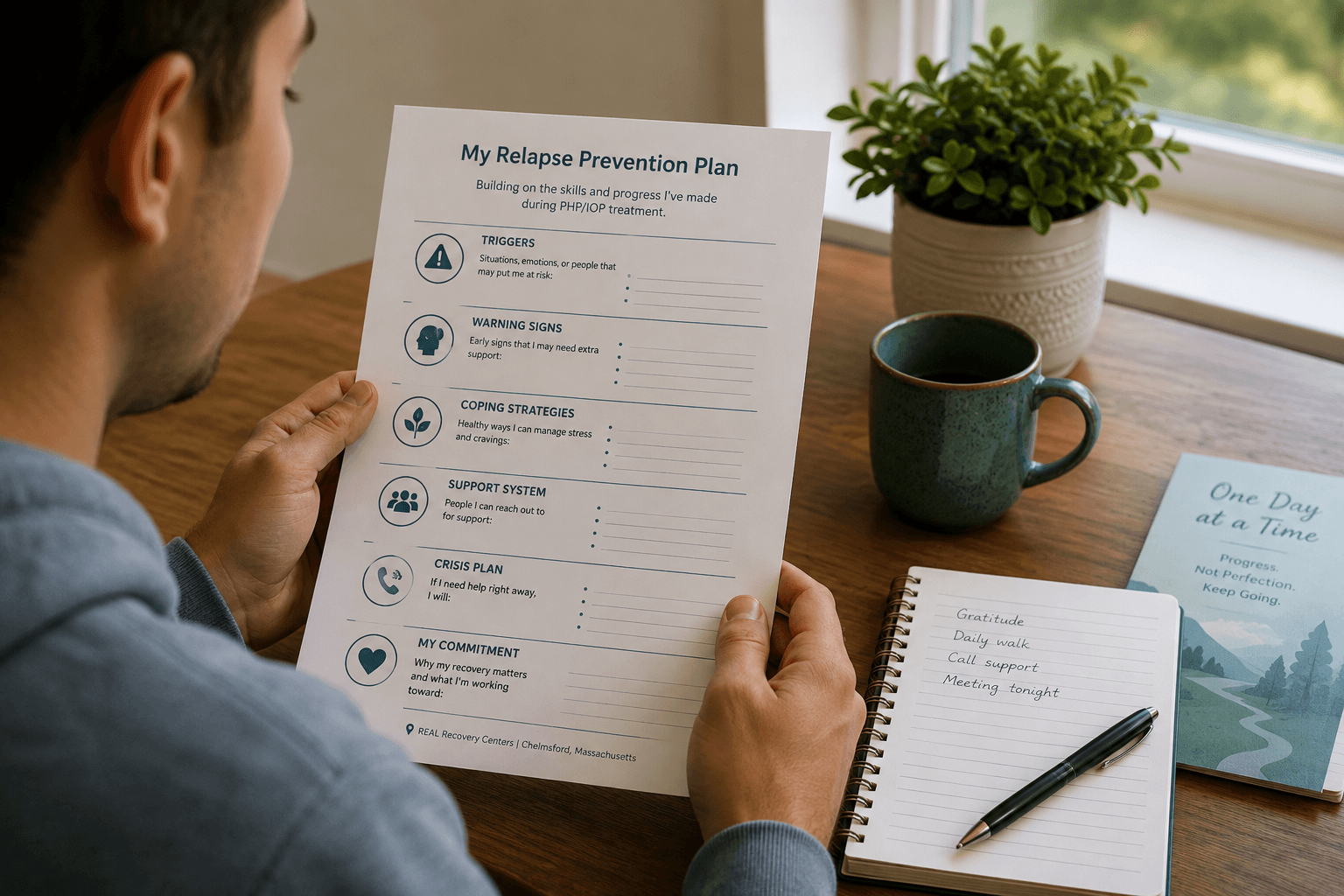
Regular check-ins with a case manager or counselor catch early warning signs before they become a crisis. A relapse prevention plan built during treatment gets revisited and adjusted here, since the plan that worked in week one of IOP often needs updating once real-world triggers show up again.
Practical support matters just as much as clinical support during this window. A case manager can help with a return to work, a new daily schedule, or simply being someone to call before a difficult event rather than after it.
What the First 90 Days Typically Look Like
The first two weeks after discharge are usually the highest-frequency period, often with a check-in the team schedules within 48 to 72 hours of discharge. This isn’t because something is likely to go wrong; it’s because the routine disappearing abruptly is itself a risk worth managing actively.
Weeks three through eight typically shift to weekly group or individual sessions alongside alumni programming. By week nine through twelve, many people are transitioning to a lower-frequency continuing care schedule, sometimes biweekly or monthly, depending on how the first two months went.
This isn’t a fixed script. Someone managing more risk factors, such as an unstable living situation or a recent difficult event, might stay in a higher-frequency schedule longer.

Why Informal Support Isn’t a Substitute for Structured Aftercare
Peer groups like AA or NA are genuinely valuable, and most structured aftercare programs encourage rather than replace them. What they don’t provide on their own is clinical monitoring, a therapist tracking specific warning signs, or a documented plan tied to what came up during PHP or IOP.
The difference matters most in the first few weeks. A peer group meeting once a week is a good complement to structured aftercare, but as a substitute it misses the clinical check-in that catches a shift in mood or routine before it becomes a pattern.
Combining structured aftercare with peer support, rather than choosing one over the other, is what the continuing care research actually points to. Most people who stay engaged with both report feeling less alone in the process, since one covers the clinical piece and the other covers the everyday reality of staying connected to people who understand what early recovery is like.
Getting Aftercare Support in Massachusetts
Real Recovery Centers is a BSAS-licensed provider offering structured aftercare and alumni programming for people completing PHP, IOP, or outpatient treatment across Greater Lowell and Middlesex County. Scheduling is flexible around work and family obligations, and most major Massachusetts insurance plans cover continuing care once a clinician documents the need.
You can verify your insurance coverage online before your first call. Our team is available 24/7 at (978) 788-1870, whether you’re planning ahead before discharge or already a few weeks into recovery and want more structure.
The Family’s Role During This Window
Family involvement doesn’t end when formal treatment does. The people around someone in early recovery are often the first to notice a shift in mood, sleep, or routine, sometimes before the person in recovery notices it themselves.
Family therapy during the aftercare window focuses less on processing the past and more on practical coordination. That often means agreeing together on what daily support looks like and on who gets called first if a warning sign shows up.
That plan matters more than good intentions alone. A family that agrees in advance on what a warning sign looks like and who to call when they see one tends to respond faster and less reactively than a family improvising in the moment.
When Stepping Back Up Makes Sense
Needing more support during the first 90 days isn’t a sign that treatment failed. It’s a normal part of a nonlinear process, and structured aftercare is designed to catch that shift early rather than wait for a full relapse.
If check-ins reveal that weekly aftercare isn’t enough, stepping back into IOP for a short period is a common and reasonable adjustment. That’s a different decision than starting over, and it’s one an aftercare team can help make quickly rather than after weeks of struggling alone.
The same logic works in reverse. Someone who’s stable through the first 90 days often steps down from weekly check-ins to a lighter monthly touchpoint, freeing up structure for someone earlier in the process who needs it more.
Frequently Asked Questions
How long does aftercare typically last?
Structured aftercare is often most intensive for the first 90 days, then continues at a lower frequency for months or longer depending on individual need. There’s no fixed end date, since ongoing support is linked to better long-term outcomes, and many people stay loosely connected to alumni programming well past the first year.
Is aftercare the same as a relapse prevention plan?
Not exactly. A relapse prevention plan is one component built during treatment, while aftercare is the broader structure, including therapy, alumni connection, and check-ins, that puts that plan into practice after discharge.
What if I relapse during the first 90 days?
A relapse doesn’t erase the progress made in treatment, and aftercare programs are built to respond to it quickly rather than treat it as a failure. Reaching out immediately, rather than waiting, is what determines what happens next.
Does insurance cover aftercare and alumni programs?
Most major Massachusetts insurance plans cover continuing care and outpatient-level aftercare once a documented clinical need is established. Coverage specifics vary by plan, which is worth confirming before your first session.

Build Your First 90 Days Before You Need To
If you’re in Massachusetts and approaching discharge or already navigating the weeks after treatment, call our BSAS-licensed team at (978) 788-1870 or reach out through our contact page to set up aftercare before the structure runs out.
If you’re outside Massachusetts, our virtual treatment program may be an option depending on your state of residence, so it’s worth confirming availability directly rather than assuming we don’t offer it.

Mitchell Grant Cohen
Dr. Mitchell G. Cohen is a board-certified Internal Medicine specialist with over 34 years of experience in patient-centered healthcare. A graduate of Hahnemann University School of Medicine, Dr. Cohen completed his internship at the University Health Center of Pittsburgh, where he gained invaluable hands-on experience. He is also a certified addiction specialist, holding membership with the American Society of Addiction Medicine (ASAM).
Currently based in Nashua, NH, Dr. Cohen is affiliated with Saint Joseph Hospital, where he provides comprehensive care focusing on both internal medicine and addiction treatment. His expertise includes prevention, diagnosis, and management of adult diseases, as well as specialized care for individuals facing substance use disorders.
Dr. Cohen is committed to fostering open communication, ensuring his patients are fully informed and empowered to make confident decisions about their health and treatment options.