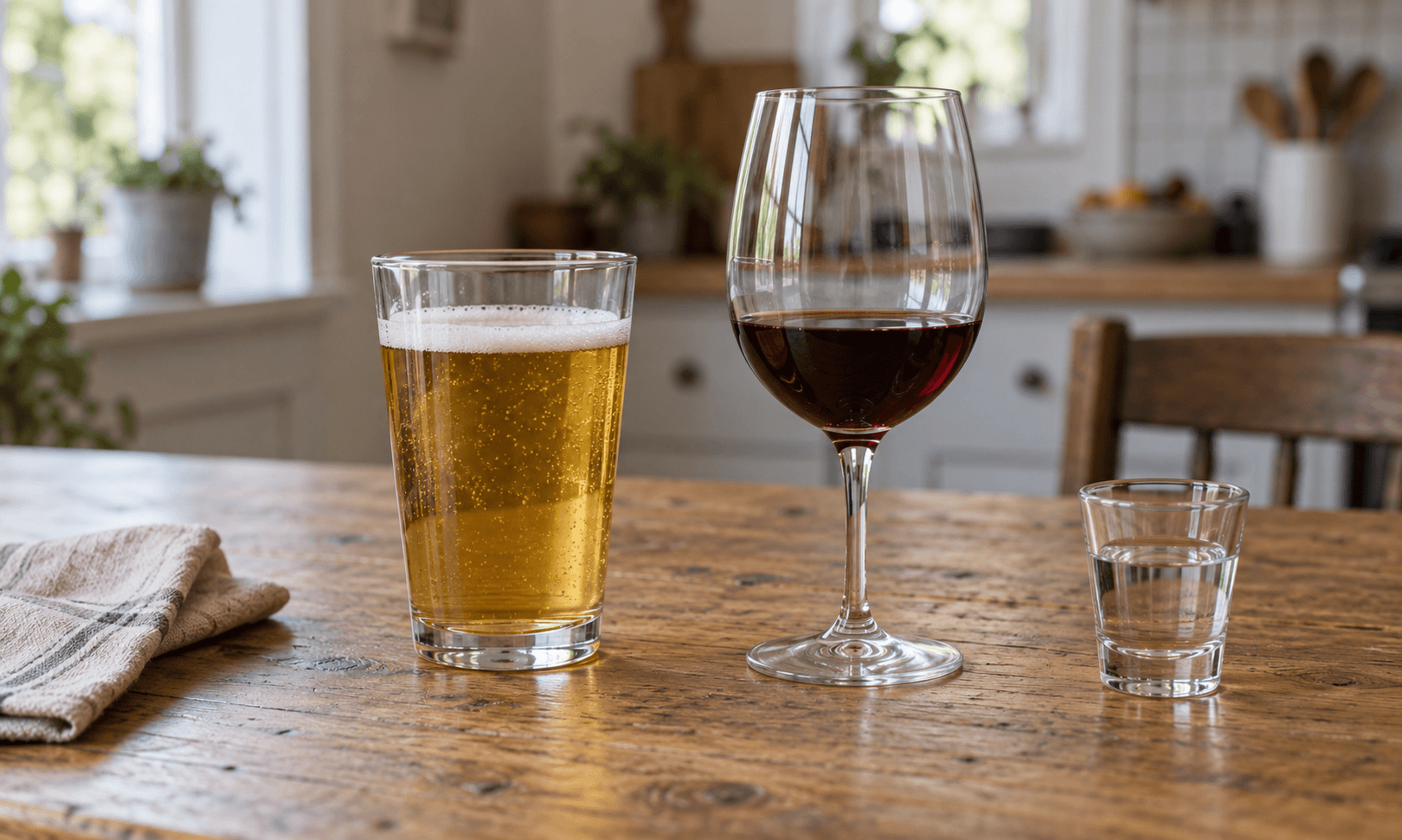
Pour a glass of wine at home, and chances are it holds more than you think. Most people measure by the glass, not the ounce, so the honest answer to “how many drinks did you have” is often higher than it feels.
Knowing what counts as a standard drink is a small shift that can make a big difference, whether you’re tracking your own habits or checking in on someone you love. It’s a question many people ask when they first start looking closely at their drinking.
If you’re asking for yourself, you’re already paying attention, and alcohol addiction treatment in Massachusetts is here whenever you want to understand your options.
What Is a Standard Drink?
In the United States, a standard drink contains about 14 grams, or 0.6 fluid ounces, of pure alcohol. That equals roughly 12 ounces of regular beer, 5 ounces of wine, or 1.5 ounces of distilled spirits such as vodka or whiskey, even though the three look very different in a glass. These amounts come from the National Institute on Alcohol Abuse and Alcoholism (NIAAA), part of the National Institutes of Health, and assume typical strengths of about 5, 12, and 40 percent alcohol by volume.
The amount of liquid in a glass doesn’t tell you how much alcohol is in it. A 12 ounce beer at 10 percent alcohol by volume holds two standard drinks, and many light beers carry about 85 percent as much alcohol as regular beer.
NIAAA also lists 8 to 10 ounces of malt liquor or flavored malt beverages, including hard seltzer, as one standard drink at about 7 percent alcohol. Strength varies by product, so the percentage printed on the label is the most reliable guide.
Why Home Pours Rarely Match
A restaurant pour and a home pour are rarely the same. Wine poured at home is often 6 to 8 ounces, which works out to roughly 1.2 to 1.6 standard drinks at 12 percent alcohol.
Mixed drinks made with two or three shots count as two or three standard drinks, not one. Craft beers can run 7 to 9 percent alcohol, so a 16-ounce pint may equal about two standard drinks.
How Many Standard Drinks Is Too Many?
Guidelines for risky drinking are measured in standard drinks, not glasses. That’s why the pour size matters so much.
NIAAA defines binge drinking as a pattern that brings blood alcohol concentration to 0.08 percent or higher. For most adults, that takes about four or more drinks for a woman or five or more for a man within roughly two hours.
NIAAA defines heavy drinking as four or more drinks on any day or eight or more per week for women. For men, it’s five or more drinks on any day or 15 or more per week.
Federal guidance on moderate drinking has also changed. The 2020 to 2025 Dietary Guidelines for Americans described it as up to one drink a day for women and two for men, but the 2025 to 2030 edition, released in January 2026, dropped those numbers and advises people to consume less alcohol for better overall health.
If your weekly total lands in the heavy range, a Half-Day Treatment Program in Massachusetts is one level of care that can provide structured support.
If getting to appointments in person is hard, virtual treatment may be an option for adults who are physically in Massachusetts during sessions.
How to Work Out Your Own Pour
You can estimate the number yourself with simple math. Multiply the ounces in your glass by the alcohol percentage written as a decimal, then divide by 0.6.
An 8 ounce pour of wine at 14 percent alcohol works out to 8 times 0.14, or 1.12, divided by 0.6. That’s almost two standard drinks in one glass.
If you want to see your real pour, measure it once with a kitchen measuring cup. Many people are surprised by the result, and that surprise is useful information, not a reason for shame.
Quick Reference: Common Drinks and Their Standard Drink Counts
These estimates use the formula above and typical alcohol strengths:
- A 12-ounce regular beer at 5 percent: about 1 standard drink
- A 16-ounce craft beer at 7 percent: about 2 standard drinks
- A 5-ounce glass of wine at 12 percent: 1 standard drink
- An 8-ounce glass of wine at 14 percent: almost 2 standard drinks
- A 1.5-ounce shot of 80-proof spirits: 1 standard drink
- A 750-milliliter bottle of wine at 12 percent: about 5 standard drinks
Why This Math Matters for Your Health
Underestimating how much you drink can hide a pattern that builds quietly. Someone who thinks they have “a couple of glasses of wine” most nights may be drinking at a heavy level, simply because home pours run larger than a standard drink.
According to NIAAA, binge and heavy drinking raise the risk of alcohol use disorder. That’s a medical condition marked by an impaired ability to stop or control drinking despite negative consequences.
Seeing the real numbers is often the first step toward noticing a pattern worth addressing. Noticing is a sign of awareness, not failure.
When Counting Drinks Isn’t Enough
Many people start tracking standard drinks out of curiosity, and some find the number is higher and more frequent than they expected. That realization is not a diagnosis, but a few signs suggest a deeper conversation may be worthwhile:
- Drinking to cope with stress, sleep, or anxiety rather than for enjoyment
- Wanting to cut back but finding it harder than expected
- Needing more alcohol to feel the same effect
- Noticing an impact on relationships, work, or how you feel day to day
A professional assessment can help sort out what the numbers mean for you and which level of care may fit. For people who want more daily structure, a partial hospitalization program in Massachusetts is one option.
Stopping suddenly after heavy, regular drinking can cause withdrawal that may be medically serious, so talk with a medical professional first. Real Recovery Centers coordinates referrals when medically supervised withdrawal care is needed.
If You’re Checking In on Someone You Love
Standard drinks give families a factual way to talk about drinking without labels or blame. Starting with the numbers can keep the conversation about care instead of accusation.
Lead with concern and specific observations, and be ready to listen. Your loved one may need time before they’re ready to talk about next steps.
Next Steps If Your Numbers Are Adding Up
If tracking your drinks has you reconsidering your relationship with alcohol, you don’t need to have it all figured out before reaching out. Our team can help you understand where you stand and which level of care may fit.
Wondering what your drinking numbers mean?
A short conversation can help you see where you stand, with no pressure to decide anything. Real Recovery Centers is a BSAS-licensed outpatient treatment provider in Chelmsford, and we work with most major insurance plans.
Frequently Asked Questions
Is a standard drink the same in every country?
No, countries define a standard drink differently, with amounts ranging from about 8 grams of pure alcohol in the United Kingdom to nearly 20 grams in Japan. This guide uses the U.S. definition of 14 grams, which NIAAA and other federal health agencies use.
Does a mixed drink count as one standard drink?
Often not. A mixed drink made with two or three shots of liquor counts as two or three standard drinks, even though it’s served in a single glass.
What is the difference between moderate drinking and binge drinking?
Binge drinking is a pattern that brings blood alcohol concentration to 0.08 percent, which typically takes four or more drinks for a woman or five or more for a man within about two hours. The 2025 to 2030 Dietary Guidelines for Americans no longer set a numeric limit for moderate drinking and advise consuming less alcohol for better overall health.
How many standard drinks are in a bottle of wine?
A 750 milliliter bottle of wine at 12 percent alcohol holds about five standard drinks. Stronger wines hold more.
Can tracking standard drinks help me figure out if I need treatment?
It’s a useful starting point for noticing patterns, but it is not a diagnosis on its own. A conversation with a professional can help you understand what the numbers mean for you.
What if I realize I’m drinking more than I thought?
That realization is common, and it is not something to feel ashamed of. It may simply mean it’s time to talk with someone who can help you figure out the right next step.

Know Your Pour, Then Know Your Options
If the numbers are adding up to more than you expected, our Massachusetts team is ready to listen without judgment.
Ready to talk about your drinking?
If you’re in Massachusetts, call our admissions team or send a message to talk through what your numbers mean and which support may fit.
Not in Massachusetts?
The SAMHSA National Helpline can help you find alcohol treatment and support near you.

Mitchell Grant Cohen
Dr. Mitchell G. Cohen is a board-certified Internal Medicine specialist with over 34 years of experience in patient-centered healthcare. A graduate of Hahnemann University School of Medicine, Dr. Cohen completed his internship at the University Health Center of Pittsburgh, where he gained invaluable hands-on experience. He is also a certified addiction specialist, holding membership with the American Society of Addiction Medicine (ASAM).
Currently based in Nashua, NH, Dr. Cohen is affiliated with Saint Joseph Hospital, where he provides comprehensive care focusing on both internal medicine and addiction treatment. His expertise includes prevention, diagnosis, and management of adult diseases, as well as specialized care for individuals facing substance use disorders.
Dr. Cohen is committed to fostering open communication, ensuring his patients are fully informed and empowered to make confident decisions about their health and treatment options.